Skip to content

Building Reproducible Academic Papers: A Full-Stack Automation Approach for RF Signal Processing Research

*November 15, 2025 | Ben Gilbert* Academic reproducibility has long been the holy grail of scientific research, yet most papers remain frustratingly opaque about their implementation details. After spending years wrestling with broken experiment scripts,… Building Reproducible Academic Papers: A Full-Stack Automation Approach for RF Signal Processing Research

OpenOTP

To set up OpenOTP, an open-source multi-factor authentication (MFA) solution for various platforms, you will need to install the required software, configure it with the server, and set up the user clients. Here is a… OpenOTP

Short-Signal Resilience: Learned Heads and Policy Boundaries for N < 32 IQ Classification

RF signal classification systems frequently encounter sequences shorter than their expected minimum length dueto hardware constraints, burst transmissions, or time-criticalapplications. Traditional ensemble classifiers handle this bystrict abstention—returning control to hierarchical fallbackmethods when N < 32.… Short-Signal Resilience: Learned Heads and Policy Boundaries for N < 32 IQ Classification

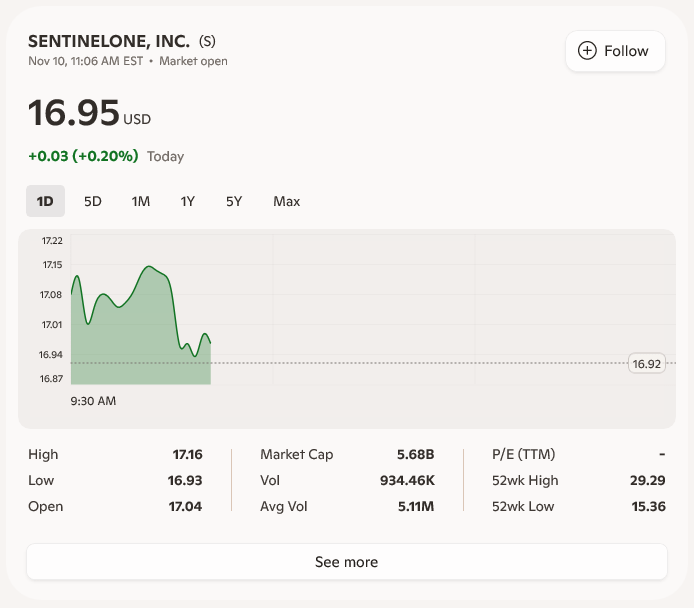
SENTINELONE, INC.(S)

Nov 10, 1:56 PM EST • Market open https://www.msn.com/en-us/money/markets/sentinelone-confluent-amplitude-upland-software-and-samsara-stocks-trade-down-what-you-need-to-know/ar-AA1POdvN https://www.marketbeat.com/earnings/reports/2025-8-28-sentinelone-inc-stock https://www.insidermonkey.com/blog/sentinelone-inc-nyses-q2-2026-earnings-call-transcript-1599700 I’m demonstrating a new Markets feature of Copilot, making this a habit remains to be seen.

Deep + Classical Co-Training Under Scarce Labels for RF Modulation Recognition

Temporal CNN over I/Q (T=128). Classicalpath: StandardScaler + RF/SVM/GBM/KNN on handcraftedfeatures. Features (16): RMS, PAPR, µI , µQ, σ2I, σ2Q, zerocrossings (I/Q), lag-1 autocorr (Re/Im), spectral centroid,spectral bandwidth, spectral flatness, peak ratio, low/high bandenergy. Co-training:… Deep + Classical Co-Training Under Scarce Labels for RF Modulation Recognition

Spectral vs Temporal vs Hybrid Inputs for RF Modulation Recognition under Aliasing Stress

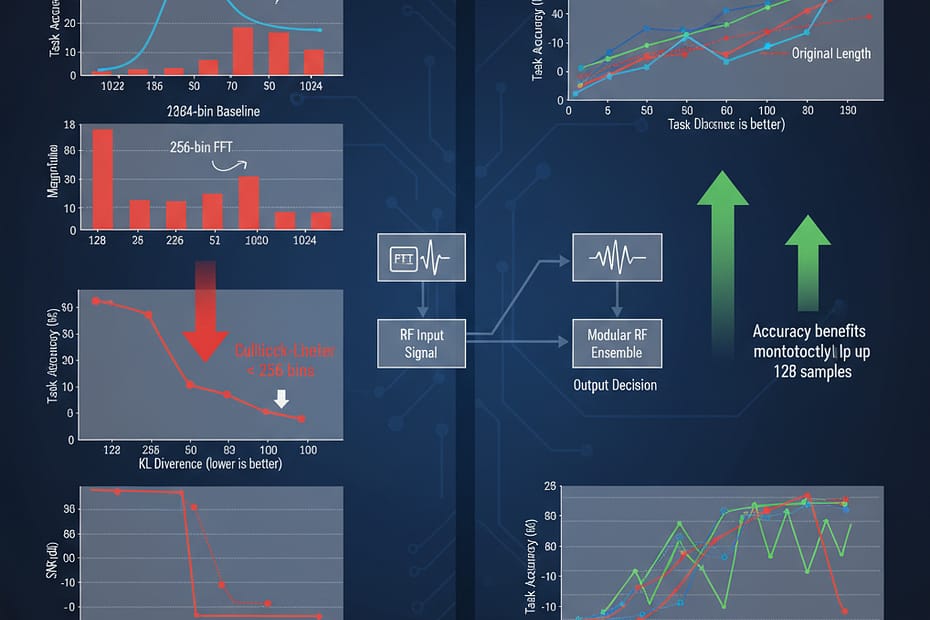
We compare spectral ( create spectral input:FFT→256), temporal ( create temporal input: 128 I/Q), andhybrid fusion ( create transformer input) for modulationrecognition. We report macro-AUROC and robustness undertest-time aliasing (integer decimation with/without anti-aliasFIR). We generate… Spectral vs Temporal vs Hybrid Inputs for RF Modulation Recognition under Aliasing Stress

Unified Design-Informed SIGINT: Fusing ATL/TWPA Priors with Adaptive Idler Proximity Scoring

Applications in Quantum Computing ATL/TWPA Design-Informed SIGINT & Unified Idler Scoring Benjamin J. Gilbert’s Research Series (arXiv:2510.24753 → Unified SIGINT) TL;DR **This work is *directly applicable* to *quantum computing readout and control systems* — especially… Unified Design-Informed SIGINT: Fusing ATL/TWPA Priors with Adaptive Idler Proximity Scoring

Multi-Role Ground Nodes as Command Relays: Reliability Anchors and Fan-Out Hubs for Routing and RF Processing

Hub Failure Scenarios for Multi-Role Ground Nodes as Command Relays Assessing Resilience and Graceful Degradation in Contested RF Control Planes By Benjamin J. GilbertExperimental Solutions Implementationbgilbert2@com.eduFull Paper PDF · Reproducible Code (coming soon)Published: October 29,… Multi-Role Ground Nodes as Command Relays: Reliability Anchors and Fan-Out Hubs for Routing and RF Processing

FFT-Only Spectral Triage for Low-Latency RF Control Planes: From 1.5 ms Digital-vs-Analog Decisions to Near-100% Command Success

Spectral triage in contested environments faces the dual challenge of rapid classification and reliable subsequent operations.FFT-based feature extraction provides deterministic latencyand interpretable spectral characteristics, making it suitablefor real-time systems where compute budgets are constrained.However, pure… FFT-Only Spectral Triage for Low-Latency RF Control Planes: From 1.5 ms Digital-vs-Analog Decisions to Near-100% Command Success